
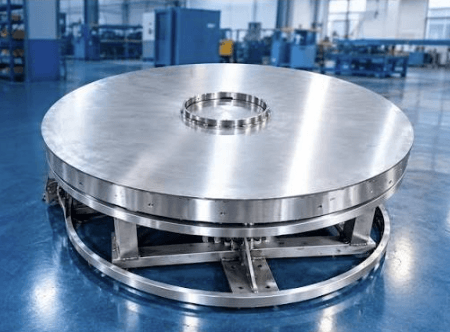
Rotating platforms are widely used in manufacturing, material handling, construction, and specialized equipment. They allow machinery, workpieces, and supporting structures to change orientation without requiring the entire system to be repositioned. For these platforms to operate reliably, their rotating interfaces must support the expected loads while maintaining controlled movement and structural stability.
Turntable bearings are important components in these applications. They provide a connection between stationary and rotating parts, helping the assembly move smoothly under the conditions specified by its design. Choosing an appropriate bearing requires more than checking its diameter or mounting pattern. Load distribution, rotational accuracy, installation conditions, and maintenance requirements all influence long-term performance.
Understanding these factors can help equipment manufacturers develop more reliable rotating systems and help maintenance teams reduce avoidable operational problems.


Understanding Turntable Bearings
A turntable bearing supports rotation between two connected structures. One part of the assembly remains stationary while the other rotates around a central axis. Depending on the application, the bearing may support a work platform, industrial fixture, lifting structure, or material-handling mechanism.
Some turntable bearings are relatively simple, while larger industrial versions may resemble slewing bearings and incorporate rolling elements, raceways, mounting rings, seals, and other specialized features. Certain configurations also include gear teeth that allow a motor-driven pinion to rotate the platform.
The required design depends on the forces involved and the way the equipment operates. A manually rotated platform used for light positioning has different requirements from a powered table carrying heavy components through repeated industrial cycles.
For this reason, the term turntable bearing covers a range of products. Engineers should verify the actual construction and specifications of a proposed bearing rather than assuming that every design offers the same capabilities.
How Turntable Bearings Support Rotational Movement
Transferring Loads Between Structures
When a platform carries a load, the bearing transfers forces between the rotating structure and its support. These forces may include axial loads acting parallel to the rotation axis, radial loads acting across the axis, and overturning moments created by an unevenly distributed load.
The bearing must accommodate the combination expected in normal operation and any relevant additional forces specified by the equipment design.
Load distribution is particularly important when a workpiece is positioned away from the center of the platform. An offset load can create a greater overturning moment than a centrally positioned load of the same weight.
See also: Creating Reliable Laboratory Conditions for Environmental Testing
Enabling Controlled Rotation
Rolling elements reduce friction between the moving and stationary parts. Depending on the design, the bearing may use balls or rollers to support the required combination of loads.
The internal geometry, raceway arrangement, clearances, and manufacturing accuracy influence rotational behavior. The correct configuration should be selected according to the application’s speed, duty cycle, precision requirements, and load conditions.
Integrating With a Drive System
Powered turntables may use electric motors, gearboxes, pinions, or other drive mechanisms. Some bearing configurations include integrated gearing, while others rely on a separate mechanism to move the platform.
The drive system must be compatible with the bearing and provide sufficient torque for the expected load and acceleration. Mounting rigidity and alignment also affect how effectively the platform rotates.
Common Industrial Applications
Manufacturing and Assembly Lines
Production facilities use rotating tables to position components for assembly, inspection, machining, or packaging. A turntable can allow operators or automated equipment to access different sides of a workpiece without moving the entire production station.
These applications may require repeatable positioning and frequent movement. Engineers should evaluate the platform’s load distribution, rotational speed, cycle frequency, and any precision requirements associated with the manufacturing process.
Material Handling and Warehousing
Rotating platforms can help workers or automated systems redirect loads during transfer, sorting, or storage operations. Depending on the design, the platform may handle containers, equipment, or other materials.
The bearing should be matched to the maximum intended load and the forces produced during starting, stopping, and repositioning. Environmental conditions such as dust and moisture should also be considered.
Construction and Lifting Equipment
Some construction machines and lifting systems use large rotating structures to position equipment or loads. In these applications, the bearing may need to support significant overturning moments as well as axial and radial forces.
The selection process should follow the equipment’s technical specifications and applicable safety requirements. A bearing intended for a light positioning table should not be substituted for a heavy-duty structural application without engineering approval.
Inspection and Testing Equipment
Rotating platforms can be useful in testing laboratories, product inspection stations, and measurement systems. They allow an object to be examined from multiple angles while keeping the surrounding equipment in place.
The required bearing accuracy depends on the measurement process. Backlash, runout, vibration, and structural deflection may influence the quality of results, so the entire assembly should be evaluated rather than the bearing alone.
Specialized Industrial Machinery
Custom machinery often requires a rotating interface designed around a specific layout, load pattern, or operating sequence. The bearing may need to fit limited installation space or work with specialized fixtures and drive components.
In such cases, clear communication between the equipment designer and bearing supplier helps establish the correct configuration before manufacturing or installation begins.
Key Factors in Bearing Selection
Load Capacity and Distribution
Begin by identifying the maximum axial and radial loads and the overturning moments expected during operation. Consider whether loads remain constant or change as the platform rotates.
Uneven loading can create localized forces that differ substantially from a simple calculation based on total weight. Where necessary, use engineering calculations and manufacturer load data to confirm the design.
Dimensions and Installation Space
The bearing must fit the available space and match the mounting arrangement. Important details include the inner and outer diameters, overall height, mounting-hole positions, and clearance around connected components.
Dimensional compatibility alone does not guarantee suitability. The bearing must also provide the necessary load capacity, stiffness, and rotational characteristics.
Rotational Speed and Precision
Different applications place different demands on rotational performance. Some platforms move slowly between positions, while others rotate frequently as part of an automated process.
Designers should consider operating speed, acceleration, stopping behavior, backlash, and positioning repeatability. Where precision is important, the motor, gearbox, control system, and platform structure must be considered together.
Environmental Conditions
Dust, moisture, temperature changes, and corrosive substances may affect bearing performance. Seals and surface treatments should be appropriate for the working environment, and maintenance access should be considered during the initial design.
Applications involving frequent cleaning or exposure to abrasive material may require additional attention to sealing and lubrication.
Evaluating Suppliers and Technical Specifications
A suitable supplier should provide sufficient technical information for the buyer to assess compatibility. This may include dimensional drawings, load ratings, internal design details, mounting instructions, lubrication guidance, and relevant quality documentation.
When reviewing LYHGB Bearing Turntable Bearings buyers should compare the proposed product specifications with the actual requirements of the rotating platform. If the application involves unusual loads, restricted dimensions, or a specialized drive arrangement, technical review may be needed before confirming the order.
Providing accurate information helps improve the selection process. Useful details include platform dimensions, maximum load, load distribution, rotational speed, operating environment, and expected working cycle.
Purchasing decisions should also consider manufacturing consistency, delivery planning, technical communication, and the availability of installation guidance. A low initial purchase price may not represent the best value if the component creates compatibility issues or requires repeated corrective maintenance.
Installation and Maintenance for Dependable Operation
Correct installation is essential to the performance of a turntable bearing. Before assembly, inspect the mounting surfaces for contamination, damage, and irregularities. Confirm that the supporting structure provides the rigidity and flatness required by the manufacturer.
Use suitable fasteners and follow the specified tightening sequence and torque values. Uneven tightening can distort the assembly and contribute to inconsistent load distribution.
If the platform uses an integrated gear, verify the gear engagement and alignment with the drive pinion. Lubricate the bearing and gearing according to the manufacturer’s instructions, using the recommended lubricant and service interval.
Routine maintenance should include checks for unusual noise, vibration, rotational resistance, lubricant leakage, seal damage, and loose mounting fasteners. The appropriate inspection schedule depends on the application, operating hours, environment, and manufacturer recommendations.
Any significant change in behavior should be investigated promptly. Keeping service records helps teams track inspection results, identify recurring problems, and plan maintenance before issues lead to prolonged downtime.
Frequently Asked Questions
1. What is the primary function of a turntable bearing?
A turntable bearing supports rotation between stationary and moving structures while carrying the loads specified for its design. It is commonly used in rotating platforms, industrial positioning equipment, and material-handling systems.
2. How do I choose a turntable bearing for a heavy platform?
Determine the axial and radial loads, overturning moments, platform dimensions, rotational speed, and mounting requirements. Compare these details with manufacturer specifications and obtain engineering verification for demanding or safety-critical applications.
3. How often should a turntable bearing be maintained?
Maintenance frequency depends on the bearing design, operating conditions, duty cycle, and manufacturer’s recommendations. Regular inspection, correct lubrication, and timely investigation of abnormal movement or noise help support reliable operation.
Conclusion
Turntable bearings help industrial equipment achieve controlled rotation while supporting the forces generated by operating loads. Their suitability depends on load capacity, mounting geometry, rotational requirements, environmental conditions, and compatibility with the complete machine.
By defining application requirements carefully, reviewing technical documentation, and following proper installation and maintenance procedures, equipment manufacturers can reduce avoidable problems and support dependable performance. A well-selected bearing provides a solid foundation for rotating platforms that must operate consistently throughout demanding industrial cycles.